“The easy way out usually leads back in” – This is one of the eleven laws mentioned in the book ‘The Fifth Discpline’ by Peter Senge. I have observed this too many times at my work place where a solution was more of an evasive move, trying to avoid the problem or use a clever alternative which hits back at us when we least expect. Last weekend I was reading the newspaper about how cane toads where introduced in Australia to control the beetle population and the result of that after some decades. The people who were interested in controlling the beetle population had a narrow view of the Australian biodiversity and did not know the long term effects of introducing the cane toads. They introduced these toads from South America to Australia.

Stuck inside

What were the results? The cane toads were not able to control the beetle population as the beetles lived at the top of the sugarcanes in the fields. The toads were not able to climb the cane to feed on them, instead the native reptile population went down drastically as they fed on these toads which had a poison sac in them killing the predators. Without the intended effects this move has resulted in altering the biodiversity of Australia at a noticeable scale. Our workplace is no different, simple tactical moves which seemed to be clever choices will result in a bigger problem often for people who succeed in the roles. The only way to not get into these types of traps is ‘Systems thinking’ and to remember that if there is an easy way out then we will usually end up back in.

Image courtesy of [Master Isolated Images] / FreeDigitalPhotos.net
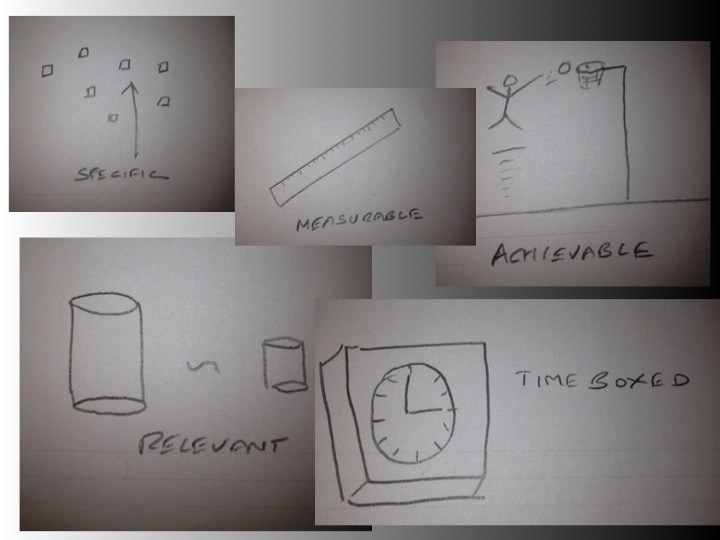
I often  stumbled on the phrase ‘A picture is worth 1000 words’; but it never occurred to me that I could take notes in the form of pictures until I read the book “The Back of the Napkin”. I came across the acronym SMART many times in many reading materials but I found it difficult to recollect. From the learnings of the book “The Back of the Napkin” I took notes in the form of doodles and I was able to recollect it easily. Here is my doodle.

SMART

I also noted that drawing doodles or mindmaps during meetings helped me to concentrate a lot, an explanation given to that kind of concentration is that I am a visual learner; other types of learners are auditory and kinesthetic. Doodling consumes some resources of my brain such that it does not allow me to day dream and helps me stay focussed; also as a side effect it helps me recollect information much better. If you are a visual learner try your hands on doodles, this place could be one of your starting points – braindoodles.net. As per that website we remember just 10% of what we read but 90% of what we see.

The first thing that I noticed was the title of the audio book, which mentioned that it is ‘Illustrated’. I had my doubts, how an audio book could be illustrated, may be it was named not to clash with the book by Francesco Cirillo. The narration is lucid and it was easy for me grasp most of content while driving to office, so the illustration here was more to help paint the picture in the listener’s mind. After the drive to office when I sat down to review what I heard during the drive, that is the time I felt the disadvantage of the audio book format. Fortunately ‘The Pragmatic Bookshelf’ had made the table of contents available which helped to review the chapters after I had heard them. I would say the audio book is a complement to the Paper/e-book than a standalone audio book.

Coming to the technique discussed in the book, I was surprised the speed at which I found the technique to be effective. The simplest change I did to myself was to handle the interruptions and backlogs well. As a consultant I was used to constant interruptions and as a result grow a huge backlog of tasks. I set aside just two pomodori every day for some tasks (like blogs, presentations) which required some concentration, I was able to accomplish those tasks in far lesser amount of time than I used to take earlier. The effectiveness of that prompted me to get a diary to help plan and record my days. I have begun to find the difference it brings by keeping me focused and organised on my tasks and also made me come to a mindset to drop or delegate tasks I am not able to do.

Will I recommend this audio book to anyone? I had a glance at the paper book in the library, compared to that I would say the audio book as a standalone makes it difficult to go back and refer or review what you have listened. The technique is very useful to learn and it makes a good impact in a short amount time, my suggestion is to go for the e-book/paper book, and proceed one chapter at a time, try to implement, review and introduce your variations. You will be surprised to see how quick it starts changing your lifestyle.