What happens when creating things becomes very easy? People will create things just for the sake of creating something without careful consideration. The best example I could see is the mobile phone app stores, within a few hours we could create an application and that made people flood the app stores with lots and lots of spammy products. Google had no other option than to intervene and remove ‘Low quality’ apps from Google play to tackle this. Still the number of apps available on the app store is so huge (600,000+ ) that it is not at all meaningful to go through lists and choose what suits us.
A twentieth century problem is that technology has become too “easy”. When it was hard to do anything whether good or bad, enough time was taken so that the result was usually good. Now we can make things almost trivially, especially in software, but most of the designs are trivial as well. This is inverse vandalism: the making of things because you can. Couple this to even less sophisticated buyers and you have generated an exploitation marketplace similar to that set up for teenagers. A counter to this is to generate enormous disatisfaction with one’s designs using the entire history of human art as a standard and goal. Then the trick is to decouple the disatisfaction from self worth–otherwise it is either too depressing or one stops too soon with trivial results.
This is not just applicable to creating software programs, it is applicable in places where automation and mass production is present in any form. We as consumers also tend to buy more of the same product once it becomes cheaper than buying something else with the saved money. This is illustrated by Jevons Paradox, technological progress that increases the efficiency with which a resource is used tends to increase (rather than decrease) the rate of consumption of that resource.
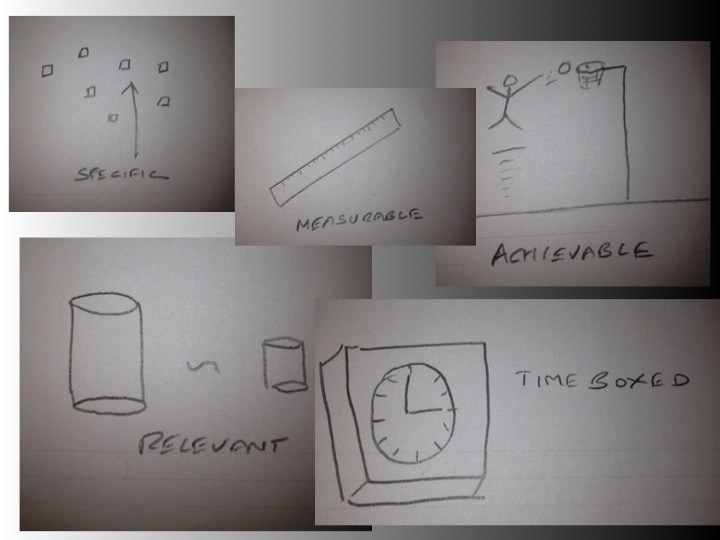
I often stumbled on the phrase ‘A picture is worth 1000 words’; but it never occurred to me that I could take notes in the form of pictures until I read the book “The Back of the Napkin”. I came across the acronym SMART many times in many reading materials but I found it difficult to recollect. From the learnings of the book “The Back of the Napkin” I took notes in the form of doodles and I was able to recollect it easily. Here is my doodle.
I also noted that drawing doodles or mindmaps during meetings helped me to concentrate a lot, an explanation given to that kind of concentration is that I am a visual learner; other types of learners are auditory and kinesthetic. Doodling consumes some resources of my brain such that it does not allow me to day dream and helps me stay focussed; also as a side effect it helps me recollect information much better. If you are a visual learner try your hands on doodles, this place could be one of your starting points – braindoodles.net. As per that website we remember just 10% of what we read but 90% of what we see.
As days progress, I get increasingly overwhelmed with the amount of catchup I need to do in terms of learning new things, it creates an imbalance between what we want to know and what we can do. What people do to bridge these gaps at work place is to create structured training programs to up skill people. Sugata Mitra explains in his ted talk how seemingly difficult things are grasped by people if we let the learning happen. This talk explains that people will find a way if there are enough knowledge resources available and curiosity generated at the right time.
The structured training programs barring a few are none other than comforters which provide a false sense of security. We build a training program and let people adapt to ‘get me trained & I will do what you ask’ mindset. Increasingly organisations are relying on self sufficient & self organising teams but the learning and development is still structured and top down push.
What is necessary for ‘learning to happen’?
Curiosity – People will learn at any cost if they want to know something.
Tools & Resources – Easy access means there is one less barrier.
Creative tension – Do not let people settle for the ‘status quo’.
Autonomy – Structured & classroom learnings are optimised for lesser load on the teacher, each individual is unique & should be allowes to pace their learnings.
Time & Environment to share – The more loaded we are, the more we tend to seek rest and if the environment is not conducive for sharing and collaboration then that impacts the speed at which knowledge can be acquired and shared in a group setting. It also creates peer pressure.
If you want to build a ship, don’t drum up people together to collect wood and don’t assign them tasks and work, but rather teach them to long for the endless immensity of the sea

 Novi's