Last mile problem is ubiquitous. Most of the developers think that the deployment or production readiness is not their cup of tea and stay focussed at getting their output for an input given according to the specification. Usually the last week of the release is chaotic with many dry runs and hot fixes. It is so easy to avoid the last mile problem yet so many people avoid those ways. What if the inertia of setting up build scripts & configuration are taken away? Will it be easier for developers to build ship ready applications?

Spring Boot and Gradle is a great combo to get started in the morning and ship a prototype in the evening. Much of the inertia that is present in writing ant scritps and configuring a spring application is blown away by making very simple entries. Here are some examples that makes the life of a developer easy by eliminating the complexity involved in project setup and deployments.

gradle wrapper – This creates a wrapper script for gradle such that only the first developer who sets the project needs to install or have gradle on their machine. From the next developer onwards who checks out the code, they can start using gradle through gradlew script. No installations required except a JDK and a VCS.

gradle build – If the Spring Boot’s starter web is used then this creates a uber jar with an embedded tomcat and all the library dependencies. All we need to deploy is run ‘java -jar myapp.jar’ in the required locations. Configurations can be overridden either through command line arguments or through external property files.

gradle eclipse or gradle idea – Helps in setting up the project in IDE. Once imported in IDE running a web app in debug mode is just right click, debug application on the main class.

gradle bootRun – Command line way to quickly bring up the application and test it as a whole.

Building a 12 factor app with gradle and spring-boot is very easy and uses less effort. Get the project setup with this and pair it up with a continuous delivery tool, you get a ‘Ship Ready’ application right from the first day of development.
What does a boom in an industry bring in? It brings in a shortage of talent.

What does shortage of talent bring in? It brings in a great demand for the talent.

What does great demand mean in a shortage of talent? It increases the supply in an inorganic manner and inverse vandalism occurs.

In a country called Noviland, carpentry was an expensive business dictated by undersupply of wood as the wood cutters only had access to axes. This kept carpentry and arts related to wood accessible only to the elite and the academics who studied carpentry. This brought in many skilled and intelligent people to the field who were well respected and well paid, people were committed to workmanship. Even though the forest cover was huge in Noviland, technology of axes led to a limited supply.

A wood cutter’s daughter invents a circular saw that can be driven through the bicycle gears which helps to cut trees at 10 times the pace they were used to. Suddenly the supply of wood increased ten fold and there were not enough carpenters. The demand for carpenters grew way too much that it drove their paychecks very high, prompting people to switch careers. Those who learnt other trades, tools and works now did a simple study of hammer, nails & saw and jumped into the profession.

Maintaining old work was easy as everything was in place and simple maintenance tasks were all required to keep up. New work is were all the hell broke loose. People were now getting furniture that does not last long, wooden bridges collapsed on a few days of exposure to heat and rain. People who wanted to replace their furniture dreaded at the cost of replacement and replacement failures. There were way too many carpenters and finding passionate people was next to impossible. Carpentry became a high paying job where no passion or study was required, all it matters was to know about hammer, nails and saw. Some of them who did exceptionally well were immediately made a manager and given interns to manage thereby killing passionate carpenters in the interest of scale.

Software engineering in a few countries is at this state, merely having a crash course in Java and understanding of few libraries are enough to be called as a programmer. Programming is not just writing code, it is solving a communication problem which involves many aspects. Lots of productivity is lost because of the failure to understand and implement good engineering practices. Some people pick agile as a tool to enhance productivity but do nothing to improve the capability of the developers. There are so many practices which can help us develop and release software in days & weeks but many of us are still stuck at the timescale of months & years because of the ignorance of practices as well as reduced progression on the skill level.

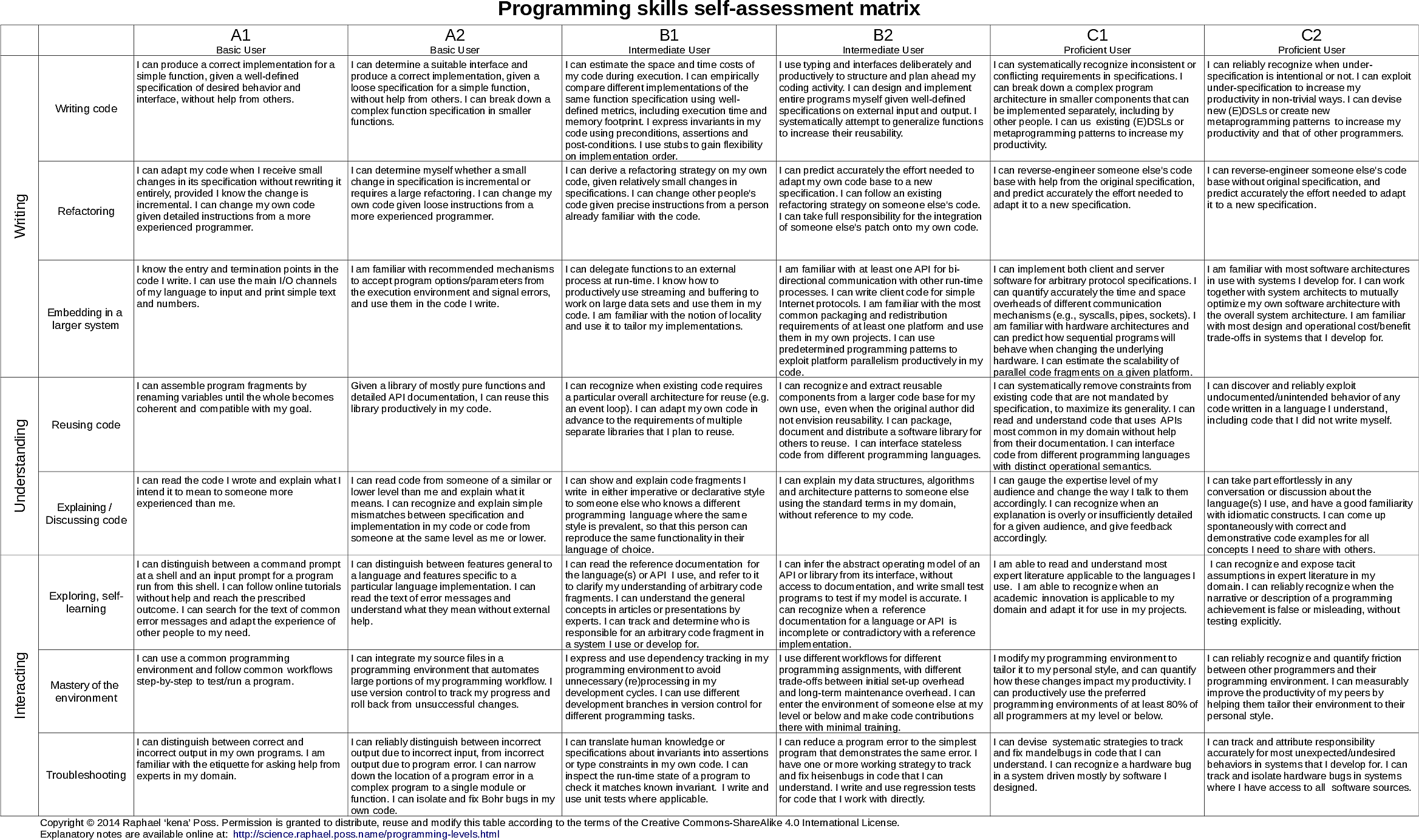
Below is a table which helps us to find where we stand in terms of skills, I can say with confidence that even with 10 years of experience many of us will not rate ourselves proficient. We should let skill and passion dominate engineering fields.

 Table source: http://science.raphael.poss.name/programming-levels.html


The first time I created an email account, I subscribed for newsletters, turned notifications on all the accounts I created in the net and was happy to spend time reading the emails I received, still the number of emails were manageable. Fast forward to now, emails have grown to be a necessary evil. Lots of people whom I meet are finding it difficult to handle the volume of emails they receive. Since it is easy to create digital copies and apparently costs nothing to include another person in the email for Just FYI, people are given an information overload through emails. It is not uncommon to hear people saying they have 10,ooo+ unread emails in their mailbox.

ID-10028680

Here are some simple rules I created so that my Inbox shows ‘Inbox (0)’ at regular intervals. It also helps me to quickly act on only the important emails when I check through my phone.

Newsletter subscriptions – Most of the sites where we use our email id, will by default have the newsletter option checked, we should make sure to uncheck it before creating new accounts. In case we accidentally subscribe to one it will still carry an unsubscribe link. Some email systems do not unsubscribe well, ruthlessly mark them as spam. It is our inbox and we have every right to deny entry to it.

Forums – These have to be filtered into a bulk folder like ‘forum/abc’, ‘forum/xyz’ depending on the no of forums and frequently read ones.

Notifications – Twitter, facebook, linkedin and many other accounts have email notifications, if we have the habit of using those accounts directly and frequently then we do not need the email notifications to be turned on.

Projects and distribution list – We will be part of the distribution lists of projects and business units, filter those into appropriate ones like the ones created for forums.

Finance – Create a filter for all financial transactions like payslips, transaction advices, statements. It should be a one stop folder to view the mails for all the transactions.

CC – The mails which we are CCed are an FYI which do not need any action, people also have a tendency to just add another person to CC; which we can read the subject line later and choose to read or drop.

Bookmarking – Time to time we get interesting links and forwards, instead of leaving them in the inbox to read later use a site that is helpful for bookmarking so that you can read them later.

With the above filter we can drastically reduce the number of emails that arrive at the inbox and we will be able to manage the lesser number of emails. The filters should be such that only the mails which are addressed to us in the ‘To’ field should be delivered in the inbox. Spend time at a manageable frequency to glance through the filters to triage them. Maintenance of the inbox is not an one time act, it is an ongoing activity

“Image courtesy of Patchareeya99 / FreeDigitalPhotos.net”.