I was having a chat with an old time ThoughtWorks developer, the topic was trending towards voluminous work and long days at work. I interjected with the point that the developers should not be willing to work long and hard hours, instead they should be lazy so that there are better tools and automations coming out of them, rather than checking boxes on long todo lists for the day.
He thought for a while and then replied “You are right, the CruiseControl continuous integration tool was born out of laziness”. He went on to explain that one of the developers felt that it was too annoying to walk up to a computer, pull code out and run the build & tests. So the person put a build loop on that machine to do that task. Someone else put a web interface to it and there a new tool was born. It left a lasting legacy in the continuous integration space. (Cruise control home page).
Why do people relate long working hours to prosperity?
The industrial revolution required a good deal of unskilled labourers who were given instructions and repetitive tasks to be done. The more they do, the more money the company makes. So overtime was rewarded with more money and people tend to stay longer to get paid overtime. The invention part of automating the repetitive tasks were left to someone else, the thought of hard and long work is rewarding stayed on even though there was a chance of a new invention that could take this entire category of job away.
After many decades of advancements in the industrial space, automations have taken a majority of space. The place where the automation as of now is not able to get into are creative spaces or knowledge work. If a job requires more than few simple steps then it is beyond the mechanical skills and involves cognitive skills. The moment when even rudimentary cognitive skills are involved, then no longer any of those incentives and hour based pay work. It is explained well in the video created from the work of Dan Pink, the author of the book Drive.
Wisdom gets passed on through generations, bosses and workers alike, people were conditioned from the childhood that hard and long work is the only way prosper. When that person becomes the boss, demands the hours and when that person is the worker, obliges to it.
Programming is a step further, it involves complex thinking which requires us to bring deeper parts of our brain to work. Andy Hunt in his book The Pragmatic Programmer talks about L-mode and R-mode, which is about using our linear mode of the brain or the rich/random mode of the brain. Though there is value for linear mode, programming benefits a great deal from the R-mode. Staring outside the window, doodling, watching the fountain, a stroll could all be more productive activities than staring at the screen and furiously typing commands for long hours because new ideas pop out when you are least expecting and unprepared.
A programmer has to be lazy, should not jump into the task at hand instead approach programming with a mindset of ‘No code is the best code’. Laziness will make us look for to remove mundane repetitive tasks out of the way which will also pop up more creative ideas through R-mode. Workplaces should also help ease the norms of equating the number of hours in seat to productivity.
Push the problem out of your foreground mind, and just “hold it lightly”. Then go for a walk, etc. That’s when insights and breakthroughs come to me.— Henri Poincaré
Boy scout rule is well known in extreme programming, people are advised to leave the code in a better state than they found it. I observe this mostly works well for programming but not elsewhere. I have always admired teachers especially the ones that teach the basics. I made it a point that if I understand something after a good deal of effort then I would make it easy for another person by simplifying it. I kept doing this at school and college, I helped people learn tough parts of algebra, chemistry and physics through easy analogies.
When I graduated and got my job, I still carried on with this work of simplifying the tough things I learnt. There was a sudden change in team composition and I had to take up the work of a sysadmin, which was difficult for someone who was in technical support and testing for a year. I spent a lot of time learning to fit in the new role and in the process making sure that the next person getting on to this will require less transition, this is the time I was in for a rude shock; I was told by one of the senior members of the team ‘if you proceed this way of simplifying things and sharing your knowledge, you will soon be out of your job’.
The intentional complexity was hard to accept, especially when the company was trying hard to reduce dependencies on people. The high complexity created many silos in the team which made replacements harder eventually causing the team’s growth to slow down. It gave a false sense of security as people were called experts in their tasks, but not learning anything new as the learning curve was too steep.
Not working together with peers or communities will lead to phase called ‘Expert beginner’ which prevents someone from becoming competent. There is a good writeup about ‘Expert Beginner’. People take pride in the complexity of the their work and put through the new comers through the same phase so that the learning curve is steep and there is still value for expert beginners.
I read an article from ‘British Bird Lovers’ which is about how red robins which are territorial in nature lost out on the learnings it had got to open sealed bottles. The birds which learnt and kept the knowledge to itself gained a lot, but its successors did not learn any. The article finishes well saying ‘Birds that flock together appear to learn faster and increase their chances to evolve and survive’.
The general tendency for people is to pass on what was handed down to them as it is, especially if they spent a lot of effort to make it work for them. If someone has a tough time getting on board at workplace, s/he will tend to keep the on-boarding process the same, largely due to the fear of someone else overtaking or replacing them. In the process creating a culture of territory and stagnation instead of co-operation and shared growth.
Eric Schmidt mentions in his presentation ‘How google works’, that the only way to consistently succeed is to attract skilled people, work as a group, care for the workplace. We should only hand down the best, leave the place better than we find, if we do it that way then together we move ahead.
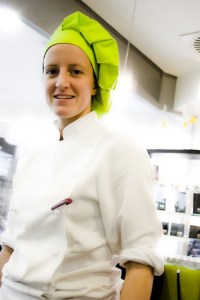
At a fine dining restaurant if I complained that I did not like the food; immediately the chef, waiter and the food taster run to the dining table to assure that I don’t feel disappointed and provide me an alternative as soon as possible. If you take a look behind the kitchen door then we will come to know that they take lots of precautions to make sure that this never happens at the dining table. Chefs have a tough time to keep taste and quality up to the mark irrespective of the availability of ingredients and limited time.
A typical restaurant is staffed with a chef, chef’s cooking assistants, butcher, waiters, manager, janitors, food tasters and a lot of machines which speed up the process of cooking. Cook’s best use of time is spent cooking the food, but does it mean the cook should not get a feel whether the food is cooked and is it as per the customization the waiter described?
Let us a take a scenario where the manager is able to hire more food tasters and shifts the burden of the quality to the food taster. Cooks will be able to create lots of dishes as per the recipe given by the chef without giving a second thought about the balance of ingredients, texture and the level of cooking required. The dish will ready to present in a finished state when it reaches the food taster, if any fault is found then the dish had to done from the beginning which will increase the workload of the cook further and reduce the output considerably as the reworks are expensive, eventually will make the customer wait more or increase dining table incidents.
What looked like a clever idea on paper backfires as cooking for fine dining is not something that could be made into a template and responsibilities could be in silos; it is a complex system with a strong feedback loop at every stage. The scene at programming is similar at many cases, developers are encouraged to write only the code and leave the testing to the QA as the perception is that the best use of a developer’s time is to make her code. Seasoned programmers know better that unit tests are also code, if you are not testing then you do not know what you program.
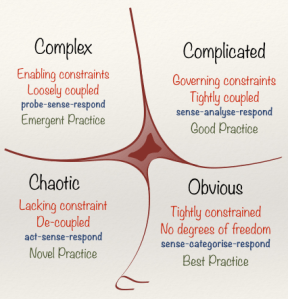
Programming is an emergent practice, which matches the complex domain in the Cynefin framework by Dave Snowden. Each project will be unique and a pattern will emerge over time which will be efficient for the team if there is a strong feedback loop. Trying to separate out of responsibilities like testing to just one small group will push the team into a cycle of code, test and fix with long feedback loops, eventually causing delays. Quality has to be assured at every stage of application development, responsiveness determines who is competitive in a complex environment.


 At a fine dining restaurant if I complained that I did not like the food; immediately the chef, waiter and the food taster run to the dining table to assure that I don’t feel disappointed and provide me an alternative as soon as possible. If you take a look behind the kitchen door then we will come to know that they take lots of precautions to make sure that this never happens at the dining table. Chefs have a tough time to keep taste and quality up to the mark irrespective of the availability of ingredients and limited time.
 er, janitors, food tasters and a lot of machines which speed up the process of cooking. Cook’s best use of time is spent cooking the food, but does it mean the cook should not get a feel whether the food is cooked and is it as per the customization the waiter described?
 Programming is an emergent practice, which matches the complex domain in the Cynefin framework by Dave Snowden. Each project will be unique and a pattern will emerge over time which will be efficient for the team if there is a strong feedback loop. Trying to separate out of responsibilities like testing to just one small group will push the team into a cycle of code, test and fix with long feedback loops, eventually causing delays. Quality has to be assured at every stage of application development, responsiveness determines who is competitive in a complex environment.
 Novi's