While playing cricket, it takes some time to get settled into the rhythm of the game and play well as a batsman. One thing I noticed while playing is, as long as I concentrate on my game I continue playing well. The moment I admire my own shot or think that I did better than what I expected, I lose concentration and the performance dips. This was not only evident in cricket, it was more pronounced when I showed up on stage plays at school, it is imperative that I remain focussed till the end of the event.
This began to worry me when presenting to a large audience because I used to feel good that if first part of my presentation went on fine and I would lose focus for few moments before I regain it. Presentations unlike writing takes a lot of preparation and it is one time write only style of delivery. The focus for a presentation should be being present for the entire duration however the presentation turns out to be.
Q. How to stay away from analysis, course correction or recovery thoughts while presenting?
A. Think of worst case scenario – the worst possible thing that can happen is that the presentation can go bad. This will bring focus onto delivering the presentation than analyzing it midway.
Q. What about recoveries from failure? Should not I be prepared for it?
A. Garr Reynolds in his book Presentation Zen talks about how connected we should be with the subject we are talking about, such that we can weave a story around the topic we want to deliver and be able to deliver the talk even without the slides.
Q. How do I know the pulse of the audience?
A. It is better to do some homework about the audience we are delivering the talk to if we are new to presenting than to try to get the pulse of audience during the talk.
Q. How do I get to think about my talk or admire it?
A. Someone in the audience should record it for us to help us retrospect our talk.
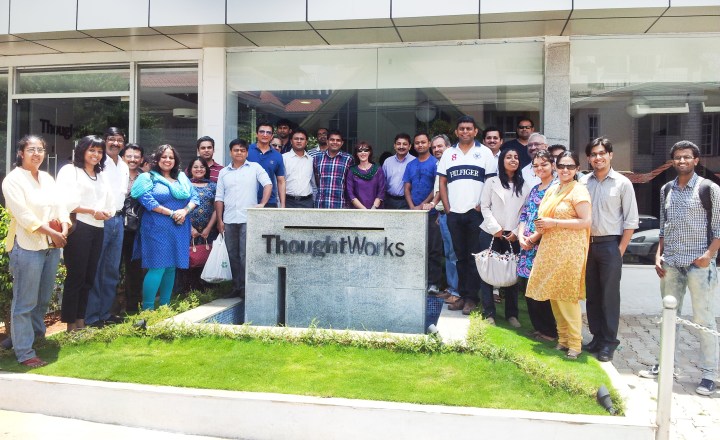
Dr. Liz Alexander visited ThoughtWorks Bangalore today (Sunday Apr 29, 2012) to give a talk about writing a non-fiction book. Many thanks to her for agreeing to give a talk on a sunday morning. It was great to hear from someone who has written 13 books and has a readership of a million.
Below are my key takeaways from talk.
Why to write a book?
The question I like to answer is ……
Who is my target audience?
Where are the audience and how do I find them?
Platform
Establish a writing platform, show up at places, expand reputation. Blogs, magazine, conferences matter.
SEO of book writing, it is OES
O-Opt-in identifier. Take into account demography and psychography.
E-Emotional hook. Can people relate themselves to the book?
S-Special sauce. Our knowledge and expertise.
Help from others
We need the help of proof readers, critical reviewers, layout artists, cover artists, page look and feel designers for a book to be of publishable quality.
Publishing
Vanity publishing vs commercial publishing
Vanity publishing requires upfront investment from the author to get it to the market.
Commercial publishing takes a lot of effort, credibility, being at the right place right time. Also pays upfront but a lion’s share of revenue goes to the publisher for the risk taken.
Ego vs care for readers
It will be tempting to push an idea into a book through vanity publishing which is like a startup idea being tried in a small office space at the corner of the road without any business plans.
The desire to sell the books written will also focus on what the readers want than trying to get the book published and not sell much.
Critical reviewers are very important to shape the final look. Friends, relatives and fans will just praise the effort without helping to improve.
Once again I thank Dr. Liz Alexander for her presence and sharing the knowledge, Rajiv Mathew for arranging the meetup.
Retrospectives are very important for every team. It brings every one in the team together into a room and make them think, discuss, reflect and take actions based on their reflections. The usual way of running retrospectives is to run at the same time every week, iteration or phase of work. This predictability also brings an element of boredom if the retrospective format is the same every time.
I observed that by changing the format of the retrospectives as per personalities and the need of the team helped a lot in running it effectively and people taking action on what they have discussed and reflected. I have used the simple Postive-Delta format many times and it has helped me get every one in the room involved for the duration of the retrospective. I have also added a pre activity and post activity to this format.
Team size: 12-16 people
Time required: 1 hour
How to do this?
Ice breaker or energizer – Any simple ice breaker to which can be completed within 5 minutes is a good start. It loosens up people and also makes them forget work if they were pre-occupied with some problem.
Reflection time – Give the team around 10 minutes of silent time to think about what went well and what needs to change. They can write it down if they think they will forget.
Writing space – Have two whiteboards or split the writing space into two. Mark one side as ‘+’ and the other side as ‘Δ’. Have white board markers in two different colours such that you can capture points in alternating colours. It is easy to read the board from every where in a hall.
Positive round – Pass a soft toy around and request the person holding the toy to give only one top positive about the retrospective period. If their top point has already been expressed by another member then add a ‘+1’ to that point ask them for their second top point and write it down. Give every one in the room a chance to give at least one point and also make sure the one with the soft toy alone speaks. At the end of the round if anyone still has a point to speak note down that as well. Do not gather any explanation for any point other than the something which can help capture the point on the board.
Delta round – Similar to ‘Positive round’ but ask for what has been nagging problem and they wish to change it. Go through the same process of capturing the points from the team as in positive round.
Analysis time – This phase can get longer if not facilitated properly. Read each point on both sides and capture ‘Action items’ and ‘Ideas’ from the team. If any point gets into a debate or a solution mode then quickly interrupt and capture the resolution of that problem to be an action item for a focussed group or the team itself based on how severe it looks.
Ownership for actions – Request for volunteers to implement the action items and try out new ideas. Capture their names against the line items on a poster to put it up in the team area later.
Recognition time – Though teams should not have heroes or heroines, it is natural for individuals to go through phases of ups and downs which makes some individuals contribute more than the others in a given span of time. Give the team the last five minutes to reach out to the individuals whom they think that life was made easy because of their help or contribution; and thank them mentioning what made their life easy. The last time I requested the team to do this I was surprised to see so much of hugging, huddling and laughter all over the room. Every one left the room on a high note.
This format of retrospective helped me to make everyone in the team talk about what matters to them and finish it off within an hour while capturing the action items and their owners. This format works well with a group size of 12-16 and only to retrospect an iteration or a phase of a project. The content in retrospectives website helps me to run effective retrospectives.

 I observed that by changing the format of the retrospectives as per personalities and the need of the team helped a lot in running it effectively and people taking action on what they have discussed and reflected. I have used the simple Postive-Delta format many times and it has helped me get every one in the room involved for the duration of the retrospective. I have also added a pre activity and post activity to this format.
 Novi's